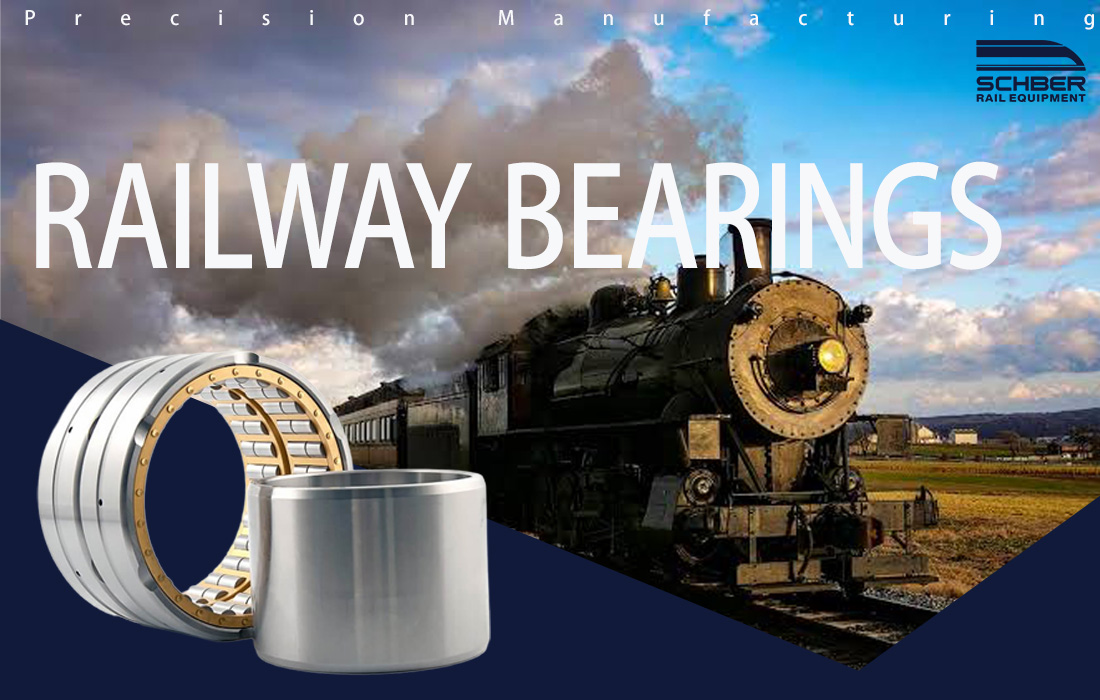
Railway bearings are critical components of railway vehicles, primarily responsible for providing rotational support, transferring loads, and controlling friction. They also directly influence the vehicle’s operational stability. Because railway vehicles operate under demanding conditions—characterized by high speeds, heavy loads, and significant vibration—the bearings must meet rigorous performance standards.
1. High Load-Carrying Capacity
Railway vehicles have substantial dead weight, and freight cars must also carry heavy cargo. Consequently, the bearings must withstand significant radial loads.Vehicle operation also generates axial forces and impact loads; therefore, railway bearings require excellent overall load-bearing capabilities. Optimized rolling element dimensions, quantities, and internal structural designs ensure stable load support.
2. Excellent High-Speed Performance
High-speed trains operate at elevated velocities, requiring bearings to withstand continuous high-speed rotation. As rotational speed increases, internal friction and heat generation also rise.Therefore, high-speed rail bearings must maintain precise rotational accuracy while keeping temperature rise, vibration, and noise levels under strict control.
High-speed performance is a core metric for bearings used in electric multiple units (EMUs) and high-speed trains.
3. Long Service Life
Railway vehicles have long operational lifecycles, and bearings undergo a vast number of rotational cycles daily. Thus, railway bearings require excellent fatigue life.Bearing materials must possess stable strength and wear resistance, and manufacturers must strictly control heat treatment and machining quality. Additionally, an appropriate lubrication strategy helps extend bearing service life.
4. Good Impact Resistance
Dynamic loads are generated when railway vehicles start, brake, or traverse track switches. Heavily loaded freight cars face even greater fluctuations in load.
Consequently, railway bearings require robust impact resistance. The bearing rings, rolling elements, and cages must maintain a stable fit, and sound structural design can help mitigate the impact forces acting on the bearing.
5. Low Friction and Temperature Rise
Friction generated during bearing operation consumes energy and produces heat; excessive temperatures can compromise lubricant performance.
Therefore, railway bearings must minimize frictional losses. Appropriate internal clearance improves operational conditions, while the correct choice of grease and fill quantity helps control temperature rise. This performance characteristic is particularly critical for high-speed bearings.
6. High Precision and Low Vibration
Railway vehicles require smooth operation. Bearing rotational precision directly impacts vibration levels.Consequently, manufacturers must strictly control the dimensional accuracy of rings, rollers, and cages. Additionally, raceway surfaces must maintain high quality.Higher manufacturing precision reduces operational vibration and minimizes abnormal noise.
7. Excellent Sealing Performance
Railway vehicles often operate in challenging environments where dust, rain, and moisture can affect the bearings.Therefore, reliable sealing structures are essential. Seals prevent contaminants from entering the bearing while also minimizing grease leakage.Effective sealing helps ensure stable bearing operation.
8. Stable Lubrication Performance
Lubrication directly influences bearing friction and wear. Insufficient lubrication increases friction and accelerates component wear, whereas excessive lubrication can lead to temperature spikes.Manufacturers must select the appropriate grease based on the bearing structure and operating conditions, while also carefully controlling the quantity of grease used.
9. Good Environmental Adaptability
Railway vehicles operate across diverse regions and climates, exposing bearings to high temperatures, low temperatures, humidity, and dust.Thus, railway bearings must maintain stable mechanical and sealing performance. Manufacturers must select materials, lubrication schemes, and sealing structures tailored to specific environmental conditions.
10. Electrical Insulation Performance
Traction motor bearings may be subject to shaft currents, which can cause electrical erosion and damage raceway surfaces.Consequently, some traction motors require insulated bearings. The insulation structure must maintain stable electrical performance while meeting the bearing’s mechanical requirements.
Summary
Railway bearings must meet a range of comprehensive performance requirements, including high load-carrying capacity, high-speed operation, long service life, impact resistance, low friction, low temperature rise, high precision, low vibration, reliable sealing, and stable lubrication.
Additionally, certain traction motor bearings require electrical insulation capabilities. Specific requirements vary depending on the vehicle type and installation location.
Therefore, selecting the right railway bearing requires a comprehensive assessment of vehicle type, installation location, load, rotational speed, environmental conditions, and lubrication parameters. Only by properly matching product performance characteristics can railway vehicles achieve long-term, stable, and reliable operation.