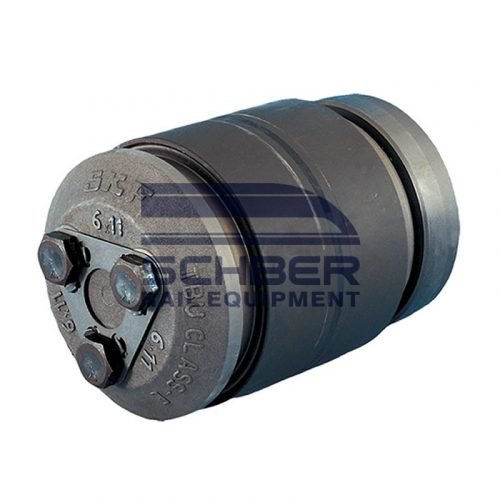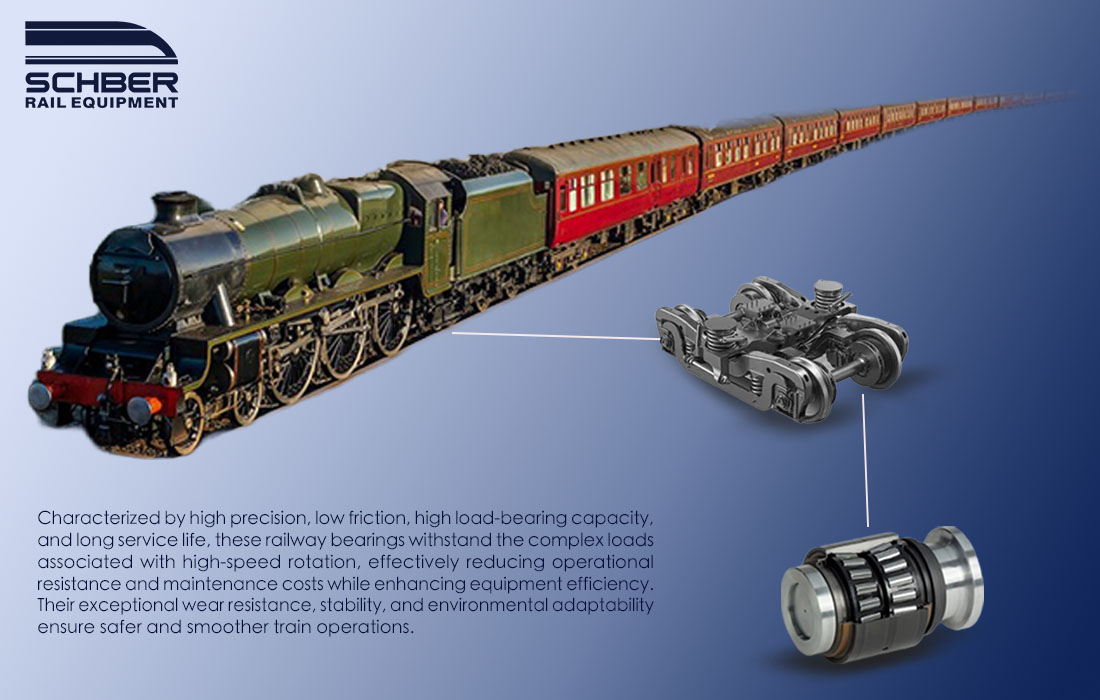
Railway bearings are critical core components of rail transport equipment (such as locomotives, freight wagons, passenger coaches, and high-speed multiple units), requiring high load-bearing capacity, high rotational speeds, high reliability, and a long service life.
Railway bearings are primarily categorized into axle-box bearings (installed at both ends of the wheelset to support the vehicle’s weight and withstand complex, alternating loads) and traction motor bearings, among others. The following is a systematic overview of common railway bearing models and related information:
I. Main Types of Railway Bearings
Due to differences in application locations and load characteristics, the following structural types are primarily used in railway vehicles:
1. Tapered roller bearings (typically double-row or paired single-row): Capable of simultaneously withstanding significant radial and bidirectional axial loads with excellent impact resistance; widely used in axle boxes for freight wagons, as well as some locomotives and passenger coaches, both domestically and internationally.
2. Cylindrical roller bearings (mostly double-row full-complement or caged designs): Feature extremely high radial load-bearing capacity and high limiting speeds; commonly used in axle boxes for high-speed trains (multiple units) and locomotive traction drive systems.
II. Typical Models and Series of Common Railway Bearings
Models commonly used by international brands and in high-speed rail (e.g., SKF, FAG):
High-speed multiple units and high-power locomotives often utilize internationally recognized technical specifications (such as the European standard EN 12080):
* FAG (Schaeffler) TAROL series bearing units:
* TAROL 130/230, TAROL 150/250, etc. (numbers indicate inner diameter/outer diameter in millimeters). These are pre-lubricated, pre-adjusted double-row tapered roller bearing units widely used in axle boxes for high-speed trains and passenger coaches in Europe and China (including both imported models and those built to indigenous standards).
* Imperial series (commonly used in North America or for specific export models): e.g., Class C (5″ × 9″), Class D (5½” × 10″), Class E (6″ × 11″), etc. * SKF Railway Axlebox and Traction Motor Bearings:
* Axlebox applications typically utilize cylindrical or tapered roller bearing units featuring specific suffixes (compliant with railway industry standards such as VA320 or VA820).
* Traction motor bearings often employ deep groove ball bearings or insulated bearings (such as the VA3091 model, featuring an aluminum oxide coating on the outer ring to prevent damage from electrical corrosion).
III. Key Technical Characteristics of Railway Bearing Designations
Railway bearing designations signify more than just dimensions; the appended codes and technical suffixes often encapsulate critical details regarding manufacturing processes and design specifications for specific operating conditions:
* Sealing and Lubrication Structures: Suffixes such as -2RZ or -RS indicate bearings equipped with high-performance contact rubber seals, enabling long service life and maintenance-free operation with grease lubrication.
* Electrical Insulation Properties: Due to the passage of variable-frequency currents, traction motor bearings often incorporate insulating coatings (e.g., SKF’s VL0241 or VA3091) to prevent premature failure caused by electrical arcing damage to the raceways.
* Materials and Heat Treatment: Railway bearing steels (such as high-purity vacuum-degassed steel) undergo specialized high-temperature tempering or dimensional stability treatments to withstand the temperature rises generated by frequent braking (operating temperatures can exceed 120°C).
* Tolerances and Internal Clearance: Manufacturing precision for railway bearings is typically far superior to that of standard industrial bearings—often meeting P6X or P5 classes or adhering to specialized railway tolerance standards—to ensure stability during high-speed rotation and to minimize vibration and noise.