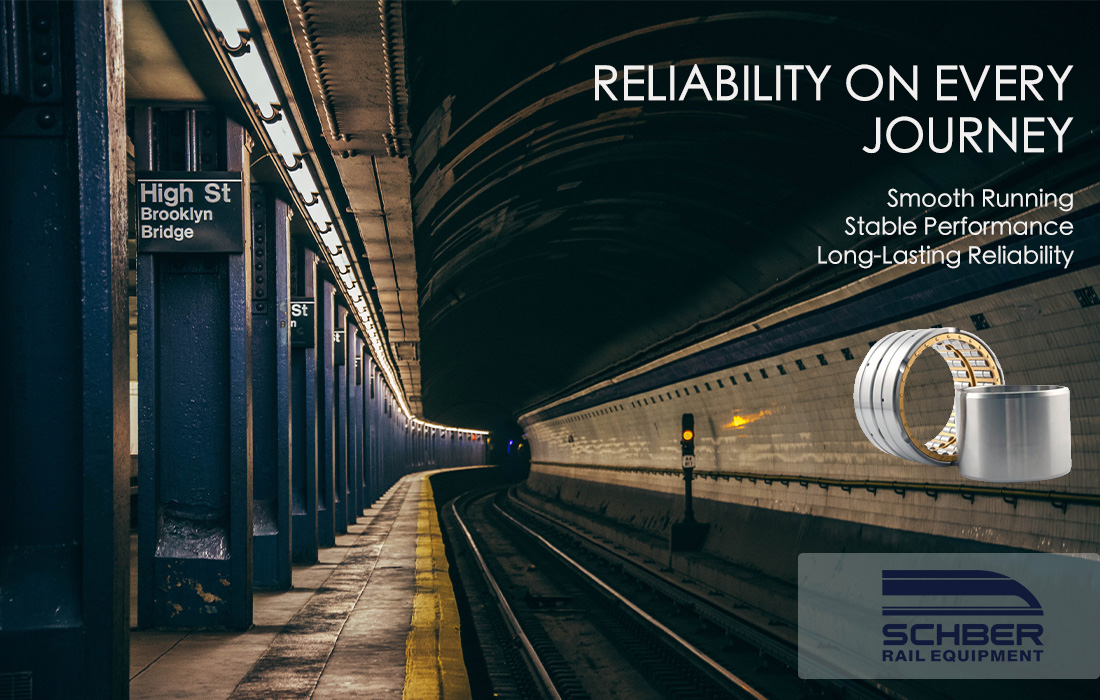
Railway bearings perform critical operational functions, connecting wheels, axles, and other key components. They must maintain stable rotation while withstanding high speeds, heavy loads, and prolonged operation.
Different types of bearings are used for various railway vehicles. Common products include axlebox bearings, wheelset bearings, traction motor bearings, and gearbox bearings.
I. Common Railway Bearing Models
There is a wide range of railway bearing models, each corresponding to specific structural designs and operational requirements.
1. Railway Cylindrical Roller Bearings
Cylindrical roller bearings offer high radial load-carrying capacity, making them suitable for railway vehicle axlebox systems.Common models include:
NU series
NJ series
NUP series
N series
These bearings are frequently used in locomotives, passenger coaches, and freight wagons. Specific models are selected based on factors such as shaft diameter, load, and operating speed.
2. Railway Tapered Roller Bearings
Tapered roller bearings can withstand both radial and axial loads, making them suitable for applications such as wheelsets and axleboxes.Common models include:
320 series
322 series
323 series
329 series
Tapered roller bearings offer excellent combined load-carrying capacity and are suitable for heavy-duty railway vehicles.
3. Railway Spherical Roller Bearings
Spherical roller bearings can accommodate a certain degree of misalignment during installation and offer high load-carrying capacity.
Common models include:
222 series
223 series
230 series
231 series
232 series
These bearings are suitable for specific railway equipment and heavy-duty operational scenarios.
4. Railway Deep Groove Ball Bearings
Deep groove ball bearings feature a compact design and offer excellent high-speed performance.
Common models include:
6000 series
6200 series
6300 series
6400 series
They are used in railway auxiliary equipment, electric motors, and other rotating components.
II. Common Applications of Railway Bearings
Railway bearings have a wide range of applications.Railway axlebox bearings are primarily used in the connection between the axle and the bogie system; they are directly critical to the operational stability of the vehicle. Railway wheelset bearings are used in wheel and axle systems and must withstand complex loads during vehicle operation.
Traction motor bearings are used in traction motors and must be capable of operating at high rotational speeds.Gearbox bearings are used in railway transmission systems and must maintain good operational stability.Different applications require different bearing configurations. Selection depends on factors such as load, speed, temperature, and installation space.
III. How to Select Railway Bearing Models
Selecting railway bearings involves more than just looking at the model number.First, confirm the bearing dimensions, including inner diameter, outer diameter, and width.Next, determine the load requirements; both radial and axial loads influence the selection.
Operating speed must also be considered, as high-speed vehicles place greater demands on bearing performance.The operating environment is equally important; factors such as temperature, vibration, dust, and humidity affect bearing performance.The lubrication method should be selected based on the specific application; a suitable lubrication strategy ensures stable bearing operation.
IV. Looking Up Railway Bearing Models
Railway bearing model numbers typically encode information regarding dimensions and structural design. Different standards may use different numbering systems.When searching for a specific model, consider the bearing type, dimensions, and application scenario.For example:
Railway bearing + model number
Railway axle box bearing + model number
Railway wheelset bearing + model number
Railway cylindrical roller bearing + model number
This search method helps you quickly locate information on the corresponding products.